
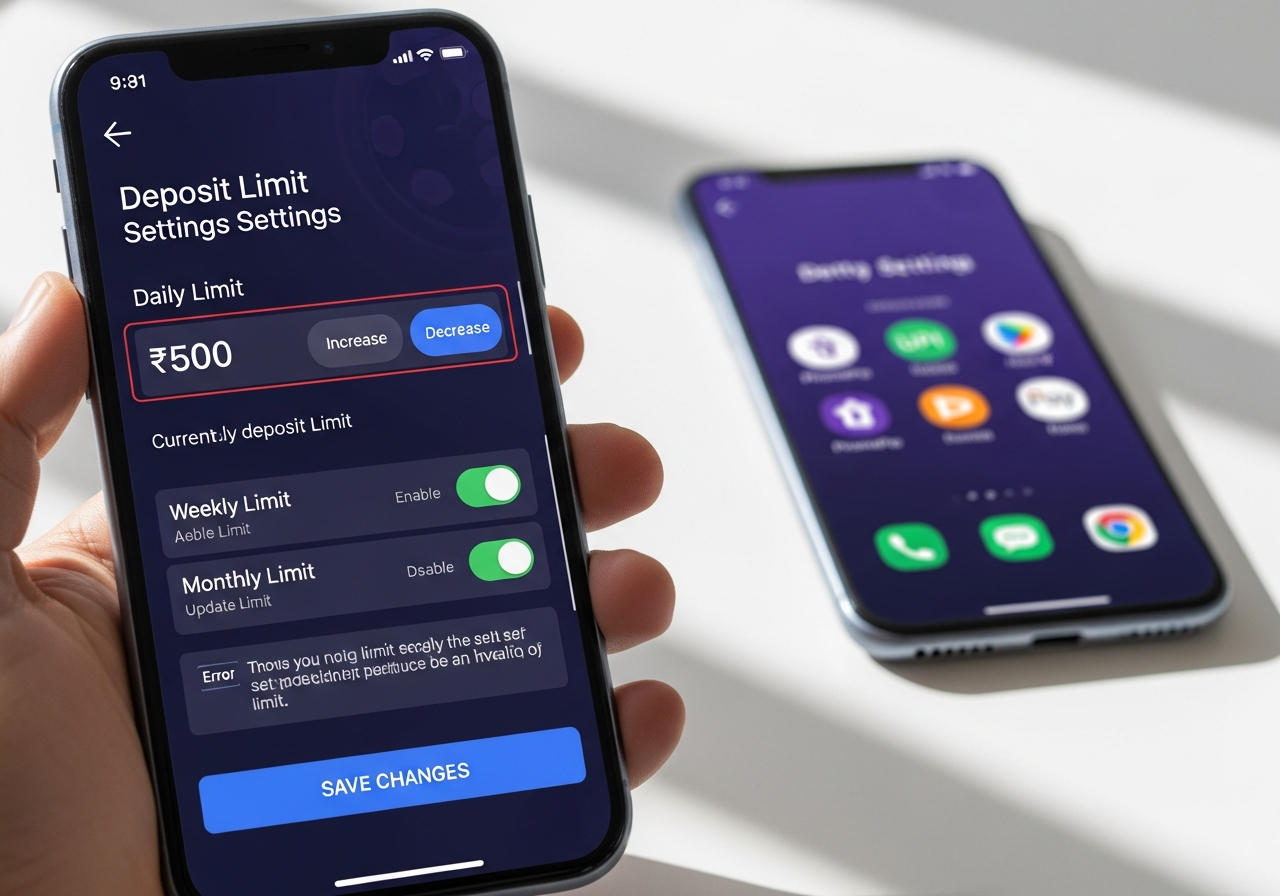
The rapid growth of online betting apps in India has transformed how millions of sports enthusiasts and casual gamblers engage with fantasy cricket, sports betting, and casino gaming. From IPL season excitement to year-round in-play wagering, these platforms have become deeply woven into Indian entertainment habits. However, this explosive expansion has also brought heightened regulatory scrutiny and enforcement actions against unlicensed operators. In this shifting landscape, one of the most practical tools available to players is the deposit limit—a feature that lets you cap how much money you can transfer into your betting account over a defined period.
This guide will walk you through everything you need to know about setting daily, weekly, and monthly deposit limits on Indian betting apps. You’ll learn how these limits work technically, step-by-step instructions for configuring them on popular platforms, how to choose a safe daily amount based on your budget, and how to combine limits with other responsible gambling tools. We’ll also explore the unique challenges Indian bettors face: ultra-low minimum deposits (₹100–₹300), instant UPI payments, and the fragmented regulatory environment where many offshore betting sites operate without clear oversight.
Why Deposit Limits Matter On Indian Betting Apps
A deposit limit is fundamentally a hard cap on how much money you can load into your betting wallet over a specific time period—daily, weekly, or monthly. Once you reach your limit, the betting app blocks any further deposits until the next period begins, regardless of welcome bonuses, promotions, or how tempting the next big match might be. This is different from your bank’s transaction limit or your UPI wallet’s daily sending cap; it’s a layer of protection you control directly through your betting account.
What Is a Daily Deposit Limit?
A daily deposit limit sets a ceiling on the total amount you can transfer into your betting account within a 24-hour period. For example, if you set a daily limit of ₹1,000, once you’ve deposited ₹1,000 that day, any attempt to add more funds will be rejected by the system. The next day at midnight or at your account’s reset time, the counter resets and you’re able to deposit again up to your ₹1,000 cap.
The beauty of this structure is its simplicity and enforcement. Unlike willpower or good intentions, a technical block prevents you from exceeding your limit—you cannot bypass it through the app’s normal deposit pathway, and most responsible platforms won’t allow you to circumvent it via customer service workarounds on the same day. This friction is intentional and protective.
The Indian Betting Landscape and Risk Factors
India’s online betting environment is highly fragmented. Many major betting brands operate from offshore jurisdictions while targeting Indian customers through mobile apps and websites. State-level gambling laws vary significantly, and there have been multiple enforcement actions and app blocking orders against unlicensed real-money gaming platforms. This legal patchwork means that while some players use well-established international sportsbooks with robust responsible gaming features, others may inadvertently use less transparent operators with minimal player protections.
Adding to the risk is the prevalence of low-minimum-deposit betting sites. Platforms that accept deposits as small as ₹100–₹300 and integrate seamlessly with UPI payment systems make it remarkably easy to top up your account on impulse. A quick lunch break, a sudden hunch about the next match, or the urge to “recover” a recent loss can result in a deposit in seconds. This friction-free environment is why self-imposed deposit limits are so critical: they inject a deliberate pause and a hard boundary between temptation and action.
How Deposit Limits Work Technically On Betting Apps
Deposit limits operate through backend systems that track your cumulative deposits over your chosen period and block further transfers when your cap is reached. Here’s how the main types function:
| Limit Type (Daily/Weekly/Monthly) | What It Controls | Typical Waiting Period to Increase | Can Be Decreased Instantly? | Common Use Case |
|---|---|---|---|---|
| Daily | Total deposits in 24 hours | 24 hours (sometimes up to 7 days) | Yes | Prevents large impulsive top-ups after losing sessions |
| Weekly | Total deposits across 7 calendar days | 7 days (sometimes 14 days) | Yes | Controls cumulative spending across a betting week |
| Monthly | Total deposits in a calendar month | 14–30 days | Yes | Aligns with payday and monthly budgeting cycles |
| Combination | All three active simultaneously | Varies by limit type | Partial (lower faster than raise) | Layered protection; whichever limit is hit first applies |
Cooling-Off Periods and Limit Changes
Most betting apps impose a waiting period before you can increase a deposit limit—typically 24 hours for daily limits and 7–14 days for weekly or monthly caps. This “cooling-off period” is intentional friction. It means if you lose ₹2,000 in an evening session and immediately want to raise your daily limit to recover, you’ll have to wait a day or more. This delay often breaks the emotional cycle and gives you time to reconsider.
By contrast, lowering your limit is almost always instant. This asymmetry—hard to raise, easy to lower—reflects responsible gambling best practices. If you want tighter control, you can activate it immediately; if you want looser rules, you must wait. Over time, this friction can reduce impulsive chasing behaviour significantly.
Step-by-Step: Setting Deposit Limits on a Popular Indian-Facing App
Most Indian-facing betting apps follow a similar workflow for setting deposit limits. Here’s a generic guide using platforms like Betway as a reference:
- Log in to your betting account via the mobile app or web browser.
- Navigate to your Profile or Account settings, usually found via a menu icon (☰) or a “My Account” link in the top right.
- Find the Responsible Gaming or Account Limits section—this may also be labeled “Player Protection,” “Limits,” or “Safer Gambling.”
- Select Deposit Limits from the available options (you may also see loss limits, session limits, or self-exclusion).
- Choose the period you want to set: Daily, Weekly, or Monthly. Many apps allow you to set all three simultaneously.
- Enter your desired limit amount in rupees. Start conservatively—this should be an amount you can comfortably afford to lose without impacting bills, rent, or savings.
- Review the confirmation screen to ensure the amount and period are correct.
- Submit and confirm. Some apps may ask for additional verification or send a confirmation email.
- Your limit is now active. Future deposits will be tracked against this cap, and once reached, further deposits will be blocked until the next period.
Navigating to Responsible Gambling Settings
If you can’t immediately spot the deposit limits option, look for these common menu labels: “Responsible Gaming,” “Account Limits,” “Player Protection,” “Safer Gambling,” or “My Limits.” On some platforms, it’s nested under Wallet or Banking settings. If you’re still stuck, use the in-app live chat or support feature and ask explicitly: “How do I set a daily deposit limit?” Responsible betting sites will have a direct answer and may even walk you through the process.
Confirming and Testing Your New Limit
After you’ve set your limit, test it with a small deposit to confirm it’s working. For instance, if you set a daily limit of ₹500, deposit ₹400 and then try to deposit another ₹200. The app should show a message stating something like “You have reached your daily deposit limit” and block the second transaction. This confirmation removes any doubt and reinforces that your limit is genuinely enforced.
Daily Limits vs Weekly and Monthly Caps: Which Should You Use?
Different periods offer different levels of control and flexibility. Here’s how they compare:
| Period | Control Level | Pros for Indian Users | Potential Drawbacks | Best For |
|---|---|---|---|---|
| Daily Only | Very tight | Prevents large single-day deposits; works well for frequent in-play bettors | May be too restrictive for weekend bettors who want to deposit once on Friday | Players prone to chasing losses same-day |
| Weekly Only | Moderate | Allows flexibility within a week; suits IPL match schedules | Easier to accumulate over 7 days without noticing; less protection against mid-week impulses | Casual bettors with stable weekly budgets |
| Monthly Only | Loose | Aligns naturally with paycheques and monthly income; minimal friction | Too distant a reset; a bad first week can set a poor tone for the rest of the month | Disciplined bettors with strong self-control |
| Daily + Weekly + Monthly | Strongest | Triple safety net; whichever hits first applies; adaptable to variable spending | Slightly complex to manage; requires initial thought | Anyone serious about responsible play |
Choosing the Right Combination of Limits
Start with a monthly limit that represents your entertainment budget. If you earn ₹50,000 per month and allocate ₹2,000 (4%) to entertainment betting, set a monthly deposit limit of ₹2,000. Divide that by four weeks to get a weekly target of ₹500, and then by seven days to get a daily suggestion of around ₹70–₹100. You might set a daily limit of ₹200 to allow flexibility for weekend matches, a weekly limit of ₹700, and a monthly limit of ₹2,500. This stacking ensures that even if you overshoot a bit on a particularly active betting day, the weekly and monthly caps will catch you.
Many Indian bettors benefit from tighter daily limits because they reduce the temptation to chase losses after a single bad session. Since most in-play betting happens impulsively during matches, a low daily cap (₹200–₹500) can be especially protective.
Indian Payment Methods and Their Own Daily Limits
Your betting app’s deposit limit isn’t the only ceiling you’ll encounter. UPI systems, PhonePe, Google Pay, Paytm, and credit/debit cards each have their own transaction caps that sit on top of your app-level limit.
| Payment Method | Typical Min Deposit on Betting Sites (₹) | Common Daily/Transaction Limit | How It Interacts With App Deposit Limits |
|---|---|---|---|
| UPI (bank-linked) | ₹100–₹500 | ₹1,00,000–₹2,00,000 per day (varies by bank) | App limit acts first; once hit, no further UPI transfers possible that day |
| PhonePe | ₹100–₹500 | ₹1,00,000 per day (typical) | PhonePe’s limit is rarely a bottleneck; app limit usually applies first |
| Google Pay | ₹100–₹500 | ₹1,00,000 per day (typical) | Similar to PhonePe; UPI infrastructure limit, not usually restrictive |
| Paytm | ₹200–₹500 | ₹50,000–₹1,00,000 per day | Paytm may have a lower ceiling on some account types; check your Paytm wallet limits |
| Debit/Credit Card | ₹200–₹500 | Varies by bank; typically ₹1,00,000–₹5,00,000 per day | Card limits rarely restrict betting deposits; app limit is the real constraint |
UPI Deposit Limits on Top Indian Betting Sites
Most major Indian-facing sportsbooks like Betway, 10CRIC, and Casumo accept UPI deposits starting from ₹100–₹500 minimum. Their maximum per transaction might range from ₹50,000 to ₹2,00,000 depending on the platform’s own rules and banking partner agreements. These site-level minimums and maximums are separate from your personal deposit limit. If a site’s minimum is ₹300 but you set a daily personal limit of ₹250, you won’t be able to deposit at all (your limit is below the site’s minimum). Conversely, if the site’s maximum is ₹50,000 but you set a daily limit of ₹500, you’re capped at ₹500 per day regardless of what the site permits.
PhonePe, GPay and Paytm Daily Sending Caps
PhonePe, Google Pay, and Paytm wallets typically allow ₹1,00,000 or more in UPI transfers per day, depending on your account tier and verification level. These are far above what most individual bettors will deposit. However, the critical point is not to treat these wallet limits as your personal betting budget. Just because you can send ₹1,00,000 via PhonePe doesn’t mean you should deposit that into your betting app. Set your personal betting app limit well below these wallet caps—perhaps ₹500–₹1,000 daily—and use the app-level limit as your true safeguard.
Minimum and Maximum Deposits on Indian Betting Apps
Indian betting apps vary significantly in their deposit thresholds:
- Ultra-low minimum (₹50–₹100): Many casual fantasy cricket and low-stakes sports apps start here, encouraging frequent small deposits.
- Low minimum (₹100–₹500): The most common tier among major sportsbooks targeting India; UPI-friendly and accessible.
- Medium minimum (₹500–₹1,000): Some premium sportsbooks or high-roller apps set a higher floor.
- Maximum deposit limits: These vary by site and payment method. Some cap daily deposits at ₹50,000, others at ₹2,00,000+. A few apps also cap total account balance to manage liability.
- No explicit maximum: A minority of platforms allow unlimited deposits, relying instead on payment processor caps and banking regulations.
How Site Min/Max Affect Your Personal Deposit Limit Strategy
Your personal deposit limit must align with the site’s minimum to allow any deposits. If a sportsbook’s minimum is ₹300 and you set a daily personal limit to ₹250, the app will reject your deposits because they fall below the site minimum. In this scenario, raise your limit to at least ₹300, or switch to a site with a lower minimum.
Conversely, never set your personal limit close to the site’s maximum just because the site allows it. If a platform permits ₹50,000 daily deposits but your monthly entertainment budget is only ₹2,000, set your daily limit to around ₹300–₹500, not ₹50,000. Your personal limit should reflect your actual bankroll and risk tolerance, not the platform’s commercial maximum.
Setting a Safe Daily Limit: Budgeting and Bankroll Management
Choosing a daily limit requires honest financial assessment. Here’s a disciplined approach:
- Calculate your monthly disposable income: This is money left after essential expenses (rent, utilities, food, insurance, loan EMIs, savings contributions). Be realistic—don’t count money that’s already mentally allocated elsewhere.
- Allocate a small entertainment share to betting: Most responsible gambling guidance suggests no more than 1–3% of disposable income. If your monthly disposable is ₹10,000, allocate ₹100–₹300 to betting.
- Divide by the number of betting days: If you plan to bet 4–5 days per week, divide your monthly allocation by roughly 20 active betting days. This gives you a safe daily average.
- Set your daily limit below this average: If your calculation suggests ₹150 per day, set your limit to ₹100–₹125 to build in a buffer.
- Remember that loss is the baseline: Each deposit should be money you’re prepared to lose entirely. It’s not an investment expected to generate returns; it’s entertainment spending.
- Avoid chasing losses through limit increases: If you lose your daily allocation, don’t immediately raise your limit or make extra deposits. Wait for the next day, week, or month to reset.
- Revisit your limit quarterly: Every three months, review whether your limit is still appropriate given your income, commitments, and betting patterns. Lower it if you notice signs of overspending or emotional distress.
Separating Gambling Money from Essential Expenses
This cannot be overstated: your betting money must be genuinely discretionary. If you’re considering borrowing for betting, cutting back on savings, or delaying essential payments to fund a bet, your limit is already too high. A common safeguard is to keep betting funds in a separate wallet or account, physically divorced from your emergency fund and bill-paying account. This prevents accidental “just this once” transfers and makes your betting budget tangible.
Adjusting Limits Responsibly Over Time
Occasionally, it’s reasonable to lower a limit (e.g., if you experience a losing streak or notice signs of problem gambling) or to cautiously increase one (e.g., after several months of stable, controlled play and improved financial circumstances). However, be wary of rapid increases, especially immediately after losses. If you find yourself repeatedly trying to raise your limit within days of hitting it, that’s a red flag that you may be chasing losses and should instead consider seeking professional help.
Responsible Gambling Tools Beyond Deposit Limits
Deposit limits are powerful, but they’re not a complete solution. Responsible betting platforms offer additional controls that work synergistically:
| Tool | What It Does | Typical Availability on Indian Apps | Best Used Together With Deposit Limits? |
|---|---|---|---|
| Loss Limit | Caps total losses in a period; if breached, your account suspends betting | Common on major sportsbooks; rare on smaller apps | Yes—directly limits financial harm |
| Wager/Stake Limit | Caps the amount you can bet per wager or per session | Available on mid-tier and premium platforms | Yes—reduces bet size to slow spending |
| Session Limit | Auto-logs you out after a set duration (e.g., 1 hour) | Common on casino-focused apps; less common on sports apps | Yes—interrupts long, repetitive sessions |
| Reality Check | Pop-up reminders showing time played and money spent | Increasingly standard; legally required in some jurisdictions | Yes—breaks spell of continuous betting |
| Self-Exclusion | Temporarily or permanently locks your account from betting | Standard on licensed platforms; absent on illegal apps | Yes—strongest tool for problem gamblers |
| Cooling-Off Period | Mandatory break before account reactivation (24 hours–30 days) | Common on major operators; not always honored by unlicensed sites | Yes—forces pause before resuming |
Combining Multiple Limits for Stronger Protection
Best practice involves stacking several tools. For example: set a daily deposit limit of ₹300, a weekly loss limit of ₹1,500, a 1-hour session limit, and use the reality check feature. If you hit your session limit, take a break. If you lose ₹1,500 in a week, stop betting until the following week. This layered approach catches problems at different angles and makes it harder to accidentally spiral into problem gambling.
Legal and Regulatory Context: Why Limits Are Critical in India
India’s regulatory landscape for online betting is fragmented and evolving. Many betting apps operate from offshore jurisdictions (Malta, Isle of Man, Curacao) and legally target Indian users in a grey zone. Meanwhile, states like Telangana and Odisha have enacted specific bans on unlicensed real-money gaming, and central authorities have periodically issued blocking orders against apps they deem illegal. There’s no unified national licensing framework equivalent to the UK’s UKGC or Malta’s MGA.
In this uncertain environment, you cannot rely solely on regulatory oversight to protect you. Self-imposed limits and responsible gambling tools become your first line of defense. A platform with transparent deposit limit controls, clear responsible gaming features, and responsive customer support is inherently safer than an opaque operator that makes these tools hard to find or use.
Licensed vs Unlicensed Apps and Availability of Limits
Established brands like Betway, 10CRIC, Casumo, and LeoVegas operate under international licenses and invest heavily in responsible gambling infrastructure. These platforms make deposit limits, loss limits, and self-exclusion easy to access and enforce reliably. By contrast, smaller or unlicensed operators may lack these tools entirely, or offer token features that aren’t actually enforced.
When evaluating a betting app, check whether deposit limits are prominently featured in the responsible gaming section. If you can’t find them after a brief search, or if in-app support can’t explain them clearly, that’s a warning sign about the platform’s commitment to player safety.
Impact of Bans and Crackdowns on Your Existing Deposits
During regulatory crackdowns, some platforms may freeze new deposits while still allowing withdrawals. Having lower daily limits reduces your exposure: if a platform you use suddenly gets blocked, you’re less likely to have a large trapped balance. For example, if you’ve maintained a ₹300 daily limit and only deposit once weekly, you might have ₹600–₹1,000 in your account. A large depositor with no limits could have ₹50,000+ stranded, facing significant loss if the operator goes down or restricts withdrawals.
Practical Examples: Daily Deposit Limit Scenarios for Indian Bettors
Real-world personas help illustrate how to set limits based on betting habits:
| Player Profile | Suggested Daily Limit (₹) | Pros of This Setup | Potential Cons | Notes on UPI/Wallet Use |
|---|---|---|---|---|
| Casual IPL/Weekend Bettor | ₹200–₹400 | Limits weekend binge deposits; covers multiple small bets; works with low-minimum sites | May be too restrictive if you want to place larger occasional bets | Deposit once or twice per week via UPI; easily within PhonePe/GPay caps |
| Frequent In-Play Punter | ₹500–₹800 | Allows daily action during match season; enough for multiple quick deposits during live games | Risk of accumulating larger totals if you deposit daily across multiple matches | Multiple rapid UPI transfers per day; monitor your Paytm/UPI sending history |
| Casino Slots Player (Low-Minimum Site) | ₹150–₹300 | Matches low-minimum site design (₹100–₹300 min); prevents extended slot sessions; encourages pausing | Very restrictive for someone wanting longer play sessions | Frequent small deposits; use a single UPI wallet to track cumulative daily send-outs |
| High-Confidence Bettor with Bankroll | ₹1,000–₹2,000 | Allows flexibility for larger bets or recovery attempts within a single day | Requires strong discipline and proven track record; risk of rationalizing overspend | Larger deposits; still well below ₹1,00,000 UPI daily caps; monitor weekly cumulative total |
Adjusting Limits Across Multiple Betting Apps
If you use more than one betting app simultaneously, your effective daily limit should be the sum of all your app-level limits, not each limit in isolation. For instance, if you use Betway with a ₹300 daily limit and 10CRIC with a ₹300 daily limit, your combined daily exposure is ₹600. This matters psychologically: you might hit your Betway limit and forget that you also have 10CRIC available, leading to higher overall daily spend than intended. Track your total daily deposits across all platforms using your UPI statement or banking app to ensure you’re respecting your true budget.
Troubleshooting, Common Mistakes, and Long-Term Discipline
Even with deposit limits in place, common pitfalls can undermine their effectiveness:
- Setting limits too high initially: Many bettors rationalize that “I have self-control, so I’ll set a high limit and just won’t use it all.” This defeats the purpose. Start low and gradually adjust only after months of proven restraint.
- Raising limits immediately after a loss: Losing ₹500 in an evening and requesting a limit increase the next morning is a classic loss-chasing signal. Respect the waiting period; use it as a cooling-off moment.
- Depositing across multiple apps to bypass limits: If you hit your ₹500 limit on App A, opening App B and depositing another ₹500 defeats the safety mechanism. Consolidate your betting to one or two trusted platforms and track the total.
- Confusing wallet/bank limits with betting limits: Your PhonePe can send ₹1,00,000 per day, but that’s not your personal betting budget. Don’t let payment infrastructure limits determine your gambling budget.
- Ignoring cooling-off periods: If you can’t increase your limit for 7 days and you’re obsessing about doing so, that obsession itself is a warning sign. Use the pause to reflect on whether you’re chasing losses.
- Neglecting to use other tools: A deposit limit alone doesn’t cover loss limits, session length, or emotional impulses. Combine it with at least a loss limit and a session timer.
When to Seek Help Beyond Self-Imposed Limits
Deposit limits are tools for self-regulation, not treatments for gambling addiction. If you consistently struggle to adhere to your limits, repeatedly attempt to override them, lie to others about your losses, or use credit/loans to fund betting, these are signs of gambling-related harm that requires professional intervention, not just tighter app settings.
Organizations like the National Council for Problem Gambling (NCPG) in India, Gamblers Anonymous, and international helplines offer confidential support. Most provide free counseling and can connect you with deeper resources. Seeking help is not a failure; it’s the responsible choice when self-regulation isn’t enough. Your deposit limit has done its job if it alerts you to a problem early enough to get support—use that awareness.