
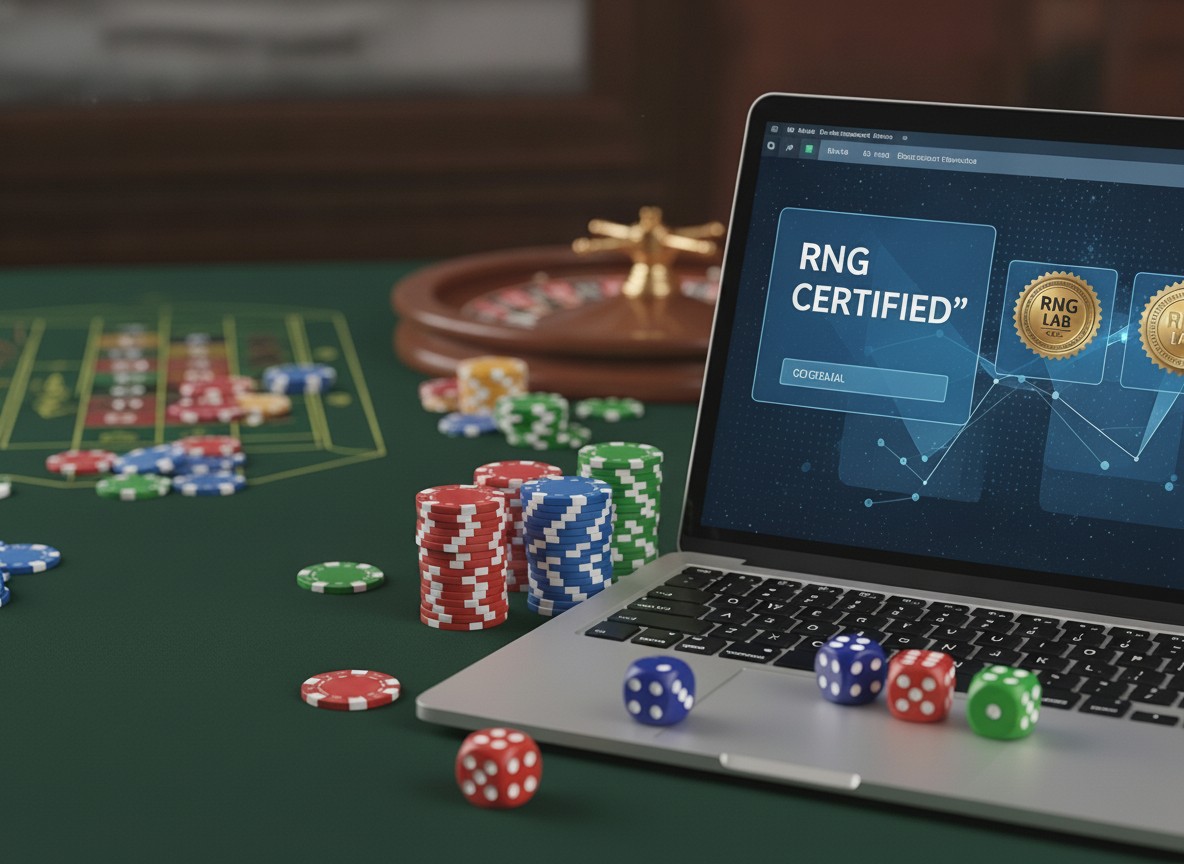
Every spin of an online slot, every card dealt in a digital poker room, and every crash prediction in an Indian real-money gaming platform depends on a single critical engine: the Random Number Generator (RNG). For millions of Indian players engaging with offshore casinos, domestic skill-based platforms and physical card rooms, understanding how RNG certification works has become essential to protecting themselves from rigged games and unfair play.
RNG certification is not just a technical badge—it is a promise backed by independent testing laboratories that every outcome in a game is genuinely unpredictable and free from manipulation. As India’s real-money gaming sector expands and regulatory frameworks evolve, RNG certification has emerged as a cornerstone of fair play, player trust and operator compliance. This practical, India-specific guide explains how RNG certification works, which global testing labs validate these systems, how Indian regulators are embracing RNG standards through codes of ethics, and what both players and operators need to know to navigate fair play in today’s competitive gaming landscape.
Understanding RNG And Fair Play In Indian Casinos
RNG is the digital engine that powers unpredictability in every modern casino game. Whether a player is spinning a reel on a slot machine, drawing cards in a virtual blackjack game, or predicting the next number on roulette, an RNG algorithm running on secure servers generates the outcome. The core principle is independence: each round’s result has no connection to the previous spin, hand or draw, ensuring that no sequence of wins or losses can be predicted or influenced.
In the Indian context, fair play depends critically on unbiased randomness because the market is fragmented across multiple formats. Offshore online casinos serve hundreds of thousands of Indian players, domestic skill-based platforms operate in gray legal zones, and physical card rooms in cities like Mumbai and Goa serve local high-stakes players. Across all these venues, the baseline expectation is that games are not secretly rigged—that a player’s money is at risk of fair loss, not theft. RNG certification provides the technical foundation for that promise.
What RNG Does In Casino Games
RNG algorithms run continuously on casino servers, generating random number sequences at incredible speeds. These numbers map directly to game outcomes: a sequence might translate to specific reel positions in a slot game, card values in a table game, or ball landing positions in roulette. The algorithm produces numbers from a vast range and at unpredictable intervals, making it mathematically impossible for either the casino operator or an external actor to predict or force a particular result.
Crucially, RNG ensures independence of outcomes. If a player loses ten consecutive spins, the eleventh spin is statistically identical in probability to the first—past results do not change future odds. This independence is what separates fair games from rigged ones. In a rigged system, software might track player patterns, adjust payout rates based on account balance, or intentionally create losing streaks to encourage larger bets. A certified RNG prevents all of these manipulations by design.
Fair Play: Randomness vs House Edge
A common misconception among Indian players is that fair RNG means equal winning chances for player and casino. This misunderstanding can fuel distrust when losses pile up. In reality, fair RNG guarantees randomness—but the game mathematics are designed to favour the house over time. This distinction is crucial.
RTP (Return to Player) percentage defines the long-term payout rate. A slot with 96% RTP means that, on average, players receive ₹96 for every ₹100 wagered over tens of thousands of spins. The remaining 4% is the house edge. A certified RNG produces unpredictable outcomes; the RTP determines the mathematical direction of those outcomes. Together, they create a mathematically fair game—fair in the sense of being non-rigged, but still profitable for the casino. This is why even certified, audited casinos remain profitable and why players can still lose money in the long run, despite randomness being genuine.
What RNG Certification Really Means
RNG certification is an independent validation process where accredited testing laboratories examine the casino’s RNG implementation and confirm it meets strict technical and statistical standards. When a lab certifies an RNG, it verifies that the algorithm produces genuinely random, unpredictable outcomes; that each round is independent of others; that the system is protected against tampering; and that long-term payout behavior matches the advertised RTP.
Certification is not a one-time stamp—it is an ongoing commitment. Labs conduct initial testing, issue certificates valid for specific periods, and conduct periodic re-audits. If a casino modifies its RNG code, changes game mathematics, or integrates new game titles, it must resubmit for certification. This continuous oversight is what makes certification meaningful in an industry where incentives to cheat can be enormous.
- Random Distribution: Lab tests verify that outcomes are evenly distributed across the full range of possible values, with no bias toward certain numbers or results.
- Independence Testing: Labs confirm that each game round produces results statistically independent of previous rounds, preventing predictable patterns.
- Seeding and Entropy: Certified systems use secure seeding mechanisms—often drawing from hardware entropy sources or secure server clocks—to initialize the RNG in ways that cannot be predicted or replicated.
- Tampering Resistance: Labs verify that the RNG code is locked in production, isolated from operator manipulation, and auditable through secure logs.
- RTP Alignment: Certification confirms that the long-term payout percentages observed in simulated millions of rounds match the declared RTP within narrow tolerance bands (typically ±0.5%).
Core Elements Of A Certified RNG
Before issuing a certification, independent testing labs follow a rigorous multi-step process to validate RNG systems:
- Technical Code Review: Laboratories examine the RNG algorithm source code, evaluating the mathematical approach (e.g., linear congruential generators, Mersenne Twister, cryptographic methods) and verifying it meets industry standards for randomness.
- Statistical Test Suites: Labs run batteries of statistical tests (Chi-square tests, Kolmogorov-Smirnov tests, NIST randomness tests) on millions of generated numbers to detect patterns, biases or deviations from expected distributions.
- Independence Verification: Labs confirm that sequences of outcomes show no statistical correlation—that knowledge of past results provides zero predictive power for future ones.
- Security Audit: Labs review how the RNG is seeded, how its code is protected in production, what logs are maintained, and whether the system can be accessed or modified by unauthorized parties.
- RTP Simulation and Validation: Labs run the certified RNG through simulated game play of millions of rounds, comparing observed payouts against declared RTPs to ensure they fall within acceptable variance bands.
Global RNG Testing Labs And What They Check
Independent testing laboratories have become gatekeepers of fairness in the global gaming industry. Their certifications are widely recognized by regulators, payment processors, and affiliate networks as proof that a casino’s games are not rigged. Several global labs dominate the market, and their seals are commonly displayed by Indian-facing online casinos.
| Testing Lab | Primary Role | Key RNG Tests | Relevance For Indian Casinos |
|---|---|---|---|
| Gaming Laboratories International (GLI) | Global leader in gaming device certification; serves land-based and online operators | Chi-square distribution analysis, entropy assessment, bitstream analysis, game math validation | GLI certification is recognized by many Indian offshore operators and payment partners; seen as gold standard for regulatory acceptance |
| eCOGRA (e-Commerce and Online Gambling Regulation and Assurance) | European-based certifier focused on player protection and responsible gaming integration | RNG randomness testing, RTP verification, bonus fairness audits, complaint handling reviews | eCOGRA’s fair play seal is widely displayed by Indian-facing casinos; combines RNG testing with responsible gambling checks |
| iTech Labs | Independent testing lab focused on gaming software and RNG validation across markets | Chi-square tests, autocorrelation analysis, statistical distribution tests, game volatility checks | Popular among Asian-facing operators; increasingly chosen by Indian real-money platforms for regional credibility |
| NMi Testing (Netherlands) | European testing body serving online and mobile gaming operators | Entropy validation, pattern detection, distribution uniformity tests, secure seeding verification | Recognized in EU and emerging markets; some Indian offshore platforms use NMi certification for European payment processor relationships |
| BMM Testlabs | Global testing authority with offices across Asia Pacific; part of Gammastack | RNG period analysis, birthday spacing tests, permutation tests, game outcome fairness | Strong presence in Asia; several Indian operators select BMM for regional recognition and compliance |
How Labs Test RNG Algorithms
RNG testing is a multi-layered process. It begins with a technical review: labs examine the algorithm’s mathematical foundation, identifying whether it uses industry-standard cryptographic methods, whether entropy is properly sourced, and whether code structure follows best practices. Labs then assess the RNG’s period—the number of unique values it can generate before repeating—to ensure the period is astronomically large (typically 2^128 or greater).
Statistical testing follows. Labs extract millions of numbers from the RNG and run them through rigorous test suites designed to catch any deviation from true randomness. A Chi-square test checks whether each bit position or outcome range is distributed evenly; the Kolmogorov-Smirnov test compares observed distributions against theoretical expectations; NIST test suites (designed by the U.S. National Institute of Standards and Technology) assess randomness at multiple levels. If any test suggests bias or pattern, certification is withheld until the algorithm is fixed.
Security analysis rounds out the process. Labs verify that the RNG code in production exactly matches the code that was tested—a critical control because a seemingly minor change could introduce predictability. They review audit logs, access controls, and cryptographic keys to ensure that no one, including casino staff, can alter the RNG mid-certification.
Certification Seals And Fair Play Labels
When a casino successfully undergoes RNG certification, it receives a seal or badge to display to players. These visual markers communicate trustworthiness at a glance.
- GLI Certified Badge: A green seal featuring the GLI logo and certification number, signifying that games have been tested for randomness, RTP accuracy and game math integrity.
- eCOGRA Fair Play Seal: A circular seal with the eCOGRA logo, often displayed prominently on casino homepages and in game lobbies, indicating RNG testing plus responsible gambling compliance.
- iTech Labs Certified Logo: A badge showing iTech Labs certification, commonly seen in Asian and Indian-facing casinos, signaling RNG validation and fair payout verification.
- NMi and BMM Certificates: Link-based certifications where players can click to view detailed audit reports; less visually prominent but highly credible with regulators.
These seals are not cosmetic—they carry legal weight. Payment processors, affiliate networks and emerging Indian regulatory bodies recognize them as evidence of due diligence. When a platform displays multiple lab certifications, it signals serious investment in fair play credibility.
Indian Regulatory Landscape: RNG And Real-Money Gaming
India’s gambling legal environment is fragmented and evolving. The Public Gambling Act of 1867 prohibits gambling in most forms, but several states—Goa, Sikkim, Nagaland and Telangana—have carved out licensing frameworks for specific gaming formats. Simultaneously, offshore online casinos operate in a gray zone, neither explicitly licensed nor explicitly banned, serving Indian players from international jurisdictions.
Into this complex landscape, the Real-Money Gaming Code of Ethics has emerged as a significant voluntary standard. Adopted by prominent Indian and Indian-facing operators, the Code commits signatory platforms to responsible gaming practices, transparent RTP disclosure, dispute resolution and—critically—RNG certification from recognized testing laboratories. While not statutory law, the Code has become a de facto compliance benchmark, particularly as Indian banks and payment processors increasingly scrutinize platforms for fairness and responsible gambling standards.
RNG Certification As A Compliance Tool In India
For Indian operators—whether offshore platforms targeting Indian players or domestic skill-based gaming companies—RNG certification has become a strategic compliance asset:
- Demonstrates adherence to voluntary codes of ethics and responsible gaming standards, reducing reputational risk and supporting marketing claims of fairness.
- Facilitates relationships with payment processors and banking partners, many of which require third-party certification before processing player deposits or withdrawals.
- Supports applications for domestic licensing in states considering new gaming regulations or skill-based gaming frameworks, as certification proves technical and mathematical integrity.
- Reduces enforcement and legal risk by providing independent third-party evidence that games are not rigged, should regulators or players launch complaints.
- Improves player trust and retention, directly impacting conversion rates and lifetime value in a competitive market driven by brand perception.
- Enables transparent RTP disclosure, allowing operators to confidently publish payout percentages supported by lab audit, differentiating from competitors that withhold this information.
How RNG Certification Ensures Fair Play For Indian Players
For Indian players, RNG certification translates into concrete protections and benefits. When a casino displays certified RNG seals, it means outcomes are mathematically unbiased, fraud risk is minimized, and disputes can be resolved with reference to independent audit evidence.
- Unbiased Winning Chances: Certified RNG guarantees that every player faces the same statistical probability on every spin, hand or round, preventing casinos from silently adjusting win rates per player or demographic group.
- Protection from Rigged Software: Independent lab testing detects hidden code or statistical tricks that would favor the house beyond the built-in edge; rigging attempts are virtually impossible under certified systems.
- Fraud Prevention and Dispute Resolution: Certified RNGs create audit trails and logs that operators can use to investigate player complaints, proving fairness in cases of disputed outcomes and building player confidence.
- Transparent Mathematical Fairness: RTP and volatility disclosures backed by certification allow players to understand long-term odds and manage bankrolls realistically, reducing complaints born from unrealistic expectations.
- Brand Loyalty and Reduced Churn: Players perceive certified platforms as trustworthy, leading to higher retention rates, larger average session sizes and reduced churn driven by fairness rumors or social media distrust narratives.
Player Trust And Transparency In India
Indian players are acutely sensitive to fairness concerns. Stories of rigged online casinos, collusion between operators and game providers, and sudden account closures without explanation circulate widely across gaming forums and WhatsApp groups. In this environment, visible RNG certification acts as a powerful trust signal.
When a casino prominently displays GLI, eCOGRA or iTech Labs seals, and provides links to detailed audit reports, it signals transparency and confidence. Indian players increasingly look for these markers before depositing money. Platforms that publish RTP ranges for each game, explain variance and volatility, and clearly describe their dispute resolution process further strengthen trust through education and openness. This transparency is not just ethical—it is a powerful differentiator in India’s crowded real-money gaming market.
Fraud Prevention And Dispute Protection
RNG certification creates accountability mechanisms that protect players. If a player disputes an outcome—claiming a winning spin was wrongly denied or a losing hand was unfair—the operator can reference lab certifications and audit logs to demonstrate the system is functioning as designed. If the lab-certified RNG is proven working correctly, the dispute likely stems from user error, connectivity issues or the player’s misunderstanding of game rules, not rigging.
Conversely, if an operator is running uncertified or fraudulent RNG software, the absence of audit evidence makes it far easier for regulators or payment processors to act against them. Payment processors increasingly request certification evidence before processing refunds or chargebacks, incentivizing operators to maintain certified systems. In India, as regulatory bodies gain resources and enforcement capacity, RNG certification will increasingly become a prerequisite for operating legally and acceptably.
RNG Certification vs Provably Fair Systems
As blockchain and cryptocurrency gaming grow, a new fairness model has emerged: provably fair systems. Unlike traditional RNG certification, which relies on third-party lab testing, provably fair uses cryptographic hashing and public verification to allow players to independently confirm that outcomes are fair, without trusting a central authority.
| Aspect | Certified RNG | Provably Fair | Implications For Indian Casinos |
|---|---|---|---|
| Trust Model | Relies on independent third-party lab certification and ongoing audits | Uses cryptographic proofs; players verify fairness themselves without trusting operator or external lab | Certified RNG requires regulatory and institutional trust; provably fair appeals to crypto-native players skeptical of centralized bodies |
| Technical Complexity | Industry standard; algorithms and procedures well-established | Newer; requires blockchain or hashing infrastructure and player understanding of cryptography | Certified RNG is simpler to implement and understand; provably fair adds technical burden but higher transparency perception |
| Regulatory Acceptance | Widely recognized by regulators, payment processors and licensing bodies | Emerging and uncertain in most jurisdictions; crypto payments create additional regulatory friction | Indian regulators and banks are more comfortable with certified RNG currently; provably fair adoption depends on crypto regulations evolving |
| Cost and Maintenance | Certification and ongoing audits cost ₹10–50 lakh+ annually; ongoing lab fees required | Typically lower ongoing costs post-implementation; blockchain integration costs are front-loaded | For Indian operators, certified RNG certification is more predictable and regulatory-friendly; provably fair better for specialist crypto platforms |
| Player Adoption In India | Widely recognized by mainstream Indian players; lab seals are understood and trusted | Still niche; Indian players unfamiliar with cryptographic verification and skeptical of unregulated crypto | Certified RNG remains the dominant and safest choice for Indian mass-market operators; provably fair useful for differentiation only in crypto-friendly segments |
Choosing The Right Fairness Model For India
For Indian-facing operators, certified RNG remains the default choice. It is recognized by payment processors, aligns with emerging regulatory expectations, and appeals to mainstream players. However, as crypto gaming grows and regulatory clarity improves, hybrid models may emerge: a casino could maintain certified RNG for mainstream games while offering provably fair crypto tables for advanced players.
Operators considering provably fair should weigh regulatory risk carefully. India’s stance on cryptocurrency remains restrictive; a platform heavily promoting provably fair and blockchain-based games may face banking and legal challenges. A conservative strategy is to offer certified RNG prominently, introduce provably fair as a supplementary option for niche audiences, and avoid marketing provably fair as superior or more secure unless regulatory and banking conditions change.
RTP, Volatility And RNG: How Math Shapes Fair Play
RNG produces randomness, but it does not define profitability. Two separate mechanisms shape fair play: the RNG (which ensures unpredictability) and the game mathematics, which includes RTP and volatility. Many Indian players conflate these, believing that a fair RNG somehow guarantees equal odds or frequent wins. Understanding the relationship between them is essential to recognizing what certification actually protects.
- RNG generates the outcome sequence: The algorithm produces a stream of random numbers that map to game results.
- Game mathematics interpret those outcomes: The underlying game code uses RTP percentages and payout tables to determine whether a random outcome results in a win or loss, and how much the win pays.
- Volatility describes the variance: Volatility indicates how swingy results are—high volatility slots might produce long losing streaks followed by massive wins, while low volatility produces frequent small wins and rare large losses.
RNG certification verifies steps 1 and 2 work as advertised. Labs simulate millions of game rounds using the certified RNG, verify that outcomes map to the correct payouts per the game’s rules, and confirm that empirical RTP over millions of rounds matches the declared percentage within tolerance (typically ±0.5%). This protects players from mathematical cheating: a casino cannot secretly lower RTP on the fly or make a game “tighter” for certain players.
How Labs Validate RTP Against RNG
RTP validation is a complex statistical process. A lab cannot simply run a casino’s game a few hundred times and declare the RTP is correct—short-term results will inevitably deviate from long-term averages. Instead, labs simulate millions of game rounds using the certified RNG, recording every outcome and payout. For a slot game with a declared 96% RTP, a lab might run 10 million spins and measure whether the empirical payout percentage falls between 95.7% and 96.3%. If it does, within that narrow band, certification is issued. If it deviates beyond tolerance, either the game math is flawed or the RNG is biased—and certification is denied until corrected.
This validation process is why RTP claims backed by lab certification carry weight. A casino claiming 96% RTP without lab backing could be lying; one displaying an iTech Labs or GLI certification report can show players the exact tolerance bands and simulation data supporting the claim.
Volatility And Player Experience In Indian Markets
Volatility describes the variance in results around the RTP. A slot with 96% RTP and high volatility might produce a 10-spin losing streak (player down ₹1000) followed by a 3-spin win streak recovering the loss and adding profit. The same slot with low volatility would produce steadier results, frequent small wins and rare large wins.
Indian players often have modest bankrolls and expect frequent wins. High-volatility games, while mathematically fair, can feel rigged when producing long losing streaks. This is where certification and transparency help: by clearly labeling game volatility, operators help players choose games matching their expectations. A player with ₹5000 should play low-volatility games; one with ₹50000 can afford high-volatility games hoping for large swings. Fair RNG still allows swingy results—fairness is about randomness and RTP accuracy, not about smoothing volatility. Understanding this distinction prevents unfairness complaints born purely from short-term variance.
Obtaining RNG Certification: A Roadmap For Indian Operators
For an Indian or Indian-facing casino operator planning to launch or upgrade games, obtaining RNG certification is a structured but substantial undertaking. The process typically takes 2–4 months and costs ₹20–50 lakh depending on lab choice, game portfolio scope and complexity.
- Select and engage a testing laboratory: Choose a lab recognized globally and by Indian payment processors (GLI, eCOGRA, iTech Labs, BMM). Request a scope of work, timeline and cost estimate.
- Prepare technical documentation: Compile RNG algorithm specifications, game math documents, RTP declarations, security architecture diagrams and compliance policies (KYC, AML, responsible gambling). Labs require exhaustive technical detail.
- Perform internal testing and quality assurance: Before submitting to the lab, run your own simulation suites (NIST, Chi-square tests) to ensure the RNG and game math are sound. This reduces iterations with the lab and speeds certification.
- Submit for initial technical review: Provide source code, deployment specifications and security logs. The lab reviews documentation and may request clarifications or modifications.
- Laboratory testing phase: The lab runs millions of simulation rounds, statistical tests and security audits. This phase can take 4–8 weeks depending on game complexity and lab turnaround.
- Remediate findings: If the lab identifies issues (biased distributions, RTP deviations, security gaps), the operator must fix them and resubmit for re-testing. Plan for 1–2 iteration cycles.
- Obtain certification and deploy: Once certification is issued, ensure production code exactly matches tested code. Do not modify the certified RNG or game math without resubmitting.
Ongoing Audits, Re-Certification And Change Management
Certification is not a permanent credential. Most labs issue certificates valid for 1–3 years, after which periodic audits are required. Additionally, any change to game math, RTP, RNG algorithm or security architecture mandates re-certification.
Many operators fail this step and unknowingly operate uncertified games. Strict change management is essential: before modifying any RNG or game parameter in production, operators must resubmit to the lab, obtain new certification, and only then deploy the update. Failing to follow this procedure creates regulatory liability and can void insurance or payment processor relationships. Indian operators should integrate certification renewal into annual compliance calendars and budget accordingly.
How Indian Players Can Verify RNG Certification
Indian players can take practical steps to verify RNG certification before depositing money. While lab certifications are complex documents, recognizing key markers is straightforward.
| Check | What To Look For | Why It Matters | Red Flags |
|---|---|---|---|
| Lab Certification Display | GLI, eCOGRA, iTech Labs or other recognized lab logos prominently displayed on casino homepage and in footer | Indicates independent testing; recognizable by payment processors and regulators | Logos are absent, poorly rendered or hidden in T&Cs; no clickable links to certificates |
| Audit Report Links | Footer or responsible gaming page provides clickable links to detailed certification reports or audit certificates (PDFs or third-party hosted) | Allows you to verify certification details, testing dates, scope and any limitations; demonstrates operator transparency | Links are broken, lead to generic pages without detail, or certificates are years out of date |
| RTP and Volatility Disclosure | Game lobby or rules page lists RTP percentage and volatility level for each game | Shows operator transparency and allows informed game selection matching your bankroll | RTP is not disclosed, labeled vaguely (e.g., “Fair” instead of percentage) or inconsistent across channels |
| Licensing and Jurisdictional Information | Legal T&Cs clearly state operator license jurisdiction (e.g., Malta, Curacao, Alderney) and license number; matches lab certification jurisdiction | Confirms operator operates under recognized regulatory framework; alignment with certification strengthens credibility | License details are absent, vague or contradict certification documentation |
| Game Provider Reputation | Games are from established, internationally recognized providers (NetEnt, Microgaming, Pragmatic Play, etc.) with their own certification | Reputable providers maintain their own RNG standards and reputations; reduces risk of operator-side rigging | Games are from unknown developers with no independent certifications or reputations |
| Responsible Gambling Features | Site provides self-exclusion, deposit limits, session time limits, reality check pop-ups and links to addiction support resources | Indicates operator takes responsible gaming seriously, often required for certified platforms; supports player protection | Responsible gambling options are absent, buried in T&Cs or non-functional |
| Customer Support and Dispute Process | Clear T&Cs describing complaint procedure, escalation path and how disputes are resolved; accessible support contact details | Shows operator transparency; certified platforms typically have formal dispute procedures backed by audit evidence | Support is difficult to reach, complaint procedures are vague or disputes are dismissed without investigation |
Distinguishing Certified Casinos From Questionable Sites
Several red flags distinguish trustworthy, certified platforms from questionable ones:
- Certification seals are absent or unverifiable: Logos without working links or reports you cannot view suggest certification is fabricated or expired.
- RTP and volatility information is withheld: Legitimate operators publish this proudly; withholding it suggests something is hidden.
- Support is unresponsive or dismissive: If you ask about RNG certification and support cannot explain it or provide evidence, the platform likely lacks proper certification.
- No clear licensing or regulatory information: Vague references to offshore jurisdiction or unwillingness to disclose license details are major warning signs.
- Unusual promotional pressure or bonus structures: Platforms offering absurdly generous bonuses or pressuring deposits may be using unsustainable practices; certified platforms with transparent math rarely need aggressive promotions.
Responsible Gambling And Fair RNG
Fair RNG is a necessary but not sufficient condition for responsible gambling. A certified, fair RNG does not guarantee that a player will win or even break even in the short term. Randomness allows big losing streaks, and the house edge ensures long-term losses for most players. Fair play protects against rigging; it does not protect against poor decision-making or chasing losses.
Indian players should approach certified casinos with realistic expectations: games are fair, meaning unbiased and non-rigged, but still mathematically disadvantageous over time. Responsible gambling means setting loss limits, treating deposits as entertainment costs rather than income, avoiding chasing losses, and using available responsible gambling tools (deposit limits, self-exclusion). Certification provides fairness, not a path to profit.
Business Impact: Why RNG Certification Is A Strategic Asset In India
From an operator’s perspective, RNG certification is a high-return business investment. Certified platforms gain access to premium payment processors, form partnerships with tier-one game studios, achieve higher conversion rates and reduce churn driven by fairness concerns.
Payment processing and banking relationships are directly affected by certification. Major payment processors and money transfer services in India increasingly require third-party certification before processing player deposits. A platform without certification faces friction—longer payment processing times, higher fees, restricted geographic reach and eventual de-banking. Certification removes these barriers.
Game studio partnerships are easier to negotiate when you hold certifications. Leading game providers like Microgaming and NetEnt prefer partners with certified systems, ensuring their games meet quality standards and reducing reputational risk. Certified operators gain faster access to new game releases and exclusive titles, creating competitive advantage.
Player conversion and retention improve measurably. Studies across the industry show that players encountering transparent RNG certifications and RTP disclosures have higher deposit conversion rates and longer session durations. Trust directly translates to revenue.
Regulatory and reputational resilience matter increasingly. As Indian enforcement capacity grows and regulatory frameworks mature, certified platforms will have stronger positions to argue fair play in disputes with regulators or players. They also withstand fairness criticism better—when social media rumors spread, certification evidence allows platforms to quickly prove compliance.
Marketing RNG Certification To Indian Audiences
Operators should weave RNG certification into branding and marketing, but carefully to avoid overpromising or misrepresenting what fairness means:
- Feature certification seals prominently in onboarding, game lobbies and marketing materials; make certifications clickable with links to full reports to demonstrate transparency.
- Educate on fair vs profitable: Explain in onboarding and responsible gambling content that certified RNG ensures fairness (unbiased, non-rigged) but not profitability; set realistic player expectations.
- Publish RTP and volatility data in game-specific pages and attract players with transparent game math; differentiate from competitors that hide this information.
- Highlight responsible gambling integration: Combine certification messaging with robust responsible gaming tools, positioning the brand as fair and protective rather than purely profit-focused.
- Create certification-focused content: Blog posts and explainer videos on RNG, RTP and fairness build trust and improve SEO, positioning your brand as educating players rather than deceiving them.
RNG certification is not a commodity—it is a trust signal that, when communicated effectively, drives higher lifetime value and lower churn in India’s competitive real-money gaming market.