
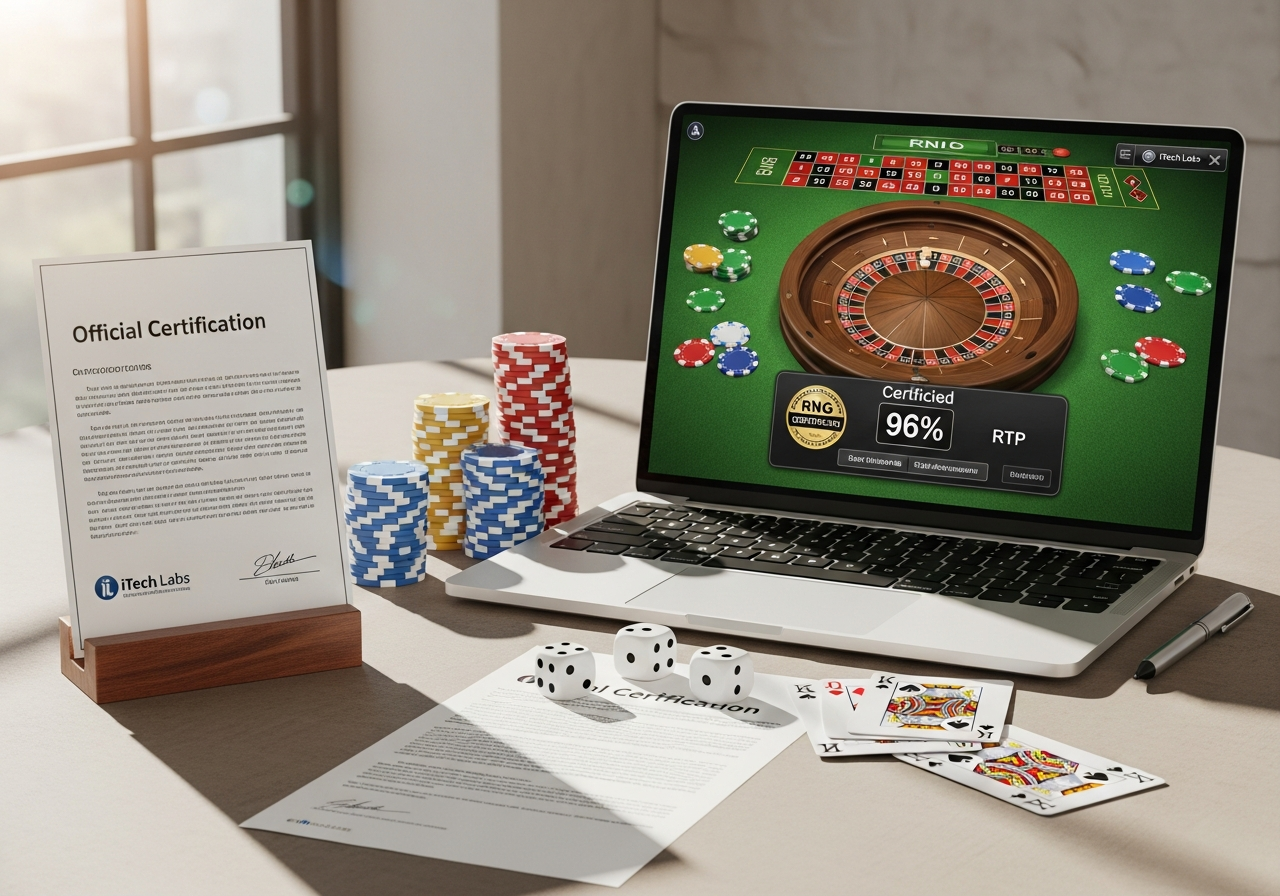
India’s online casino market has grown rapidly over the past decade, with hundreds of platforms now actively targeting Indian players. Many of these sites prominently display “fair play” badges, RNG certifications and offshore licenses, often claiming these features guarantee safe, transparent and legal gameplay. Yet for most Indian casino players, understanding what these certificates actually mean—and whether they deliver real protection—remains unclear. This article breaks down fair play certificates in plain language, explains who issues them, and shows you how to use them as one part of a comprehensive safety strategy when choosing where to play.
Fair Play in Indian Online Casinos: Why Certificates Matter
From an Indian player’s perspective, fair play means getting unbiased game outcomes, knowing the rules in advance, understanding what payouts to expect over time, and trusting that your funds and personal data are handled securely. When you sit at a live roulette table in a physical casino, you can watch the wheel spin, see the ball land and verify the result. Online, you cannot see the machinery behind the scenes. That is where fair play certificates step in: they provide third-party assurance that the digital games are genuinely random and operate as advertised.
Behind the scenes, fair play depends on two main technical pillars: random number generators (RNGs) and return-to-player percentages (RTP). An RNG is the software algorithm that generates unpredictable outcomes for every spin, shuffle or card deal. Independent testing labs verify that these algorithms truly are random and cannot be manipulated by the casino or predicted by players. RTP, meanwhile, is the long-term percentage of all wagered money that a game returns to players—for example, a slot with 96% RTP will, over millions of spins, pay back 96 rupees for every 100 rupees wagered. Fair play certificates attest that a casino’s RNG implementation and RTP calculations meet recognised industry standards.
In India’s legal grey area, where offshore platforms operate without an explicit nationwide ban, fair play certificates and offshore licenses have become key trust markers. Brands like FairPlay and others frequently highlight their certifications and licenses when marketing to Indian players, positioning these credentials as proof of safety and responsible gaming. However, it is crucial to understand that certificates improve game integrity but do not override Indian law or guarantee legal recourse if disputes arise. Fair play certificates sit within a broader ecosystem that also includes offshore regulation, KYC (Know Your Customer) identity checks, AML (Anti-Money Laundering) compliance and technical security measures. Indian players must evaluate all these layers together, not treat a single certificate as a complete safety guarantee.
How RNG and RTP Underpin Fair Casino Play
An RNG is software code designed to produce sequences of numbers or outcomes that appear random and unpredictable. For slots, the RNG determines which symbols land on each spin. For card games like blackjack or poker, it shuffles the deck. For roulette, it selects the winning number. If an RNG were predictable—say, if it always produced the same sequence when started at the same time—a player or the casino could exploit this weakness. Fair play certification requires independent labs to test the RNG code, run statistical tests to confirm randomness and verify that the algorithm cannot be reverse-engineered or manipulated.
RTP is calculated based on the game’s mathematical design. A slot machine with symbols, paylines and prize values is programmed so that, over an infinite number of spins, it returns a specific percentage of all wagers to players. Independent labs verify that the casino’s actual game code matches this design and that RTP claims are honest. For example, if a casino advertises a 95% RTP slot, the lab confirms through code review and simulation that the long-term payout truly approximates 95%.
Fair play certificates often explicitly attest that both RNG and RTP meet standards set by the lab, by international gaming bodies or by the casino’s licensing jurisdiction. This dual verification—randomness plus payout math—is what gives players confidence that outcomes are unbiased and that the casino cannot shift payouts arbitrarily.
Indian Players in a Legal Grey Area
Online gambling in India occupies a legal grey area. The Public Gambling Act of 1867 does not explicitly prohibit online betting, and individual states have varying regulations. No nationwide authority licenses or regulates online casinos for Indian players, so most platforms operate from offshore jurisdictions like Curaçao, Malta or others. This means Indian players have no direct recourse to an Indian gambling regulator if a dispute arises; instead, they must rely on the offshore jurisdiction’s framework.
Fair play certificates do improve game integrity in this environment, but they do not substitute for legal protection under Indian law. A certified-fair slot game still does not guarantee that the casino will honor your withdrawal request or that you have standing in an Indian court if the operator disputes your claim. This is why certificates alone are insufficient. You must also check the casino’s offshore license, understand its dispute resolution procedures, review its withdrawal policies and confirm that it conducts proper KYC verification. Together, these factors create a more robust safety net than any single credential can provide.
What Is a Fair Play Certificate?
A fair play certificate is a formal document issued by an independent testing laboratory or regulatory body confirming that a casino’s games or random number generators meet defined fairness criteria. The document typically includes the casino’s name, the date issued, the expiration date, the scope of testing (which games, which aspects) and confirmation that standards have been met. Some certificates focus narrowly on RNG randomness, while others cover broader aspects like game mathematics, server security and compliance with licensing requirements.
| Aspect | What It Means | Why It Matters for Indian Players |
|---|---|---|
| Issuer | Independent lab (e.g., iTech Labs) or licensing authority | Verifies credentials; a reputable lab carries more weight than a casino’s self-issued badge |
| Scope: Games | Certificate covers specific game titles (e.g., “Mega Moolah slot, Lucky Roulette”) | You know which titles are certified; uncertified games may still be fair, but lack third-party verification |
| Scope: Platform | Certificate covers all games, all providers, or just select titles | Broader scope is stronger; platform-wide certification suggests consistent fairness standards |
| Scope: RNG Only | Certificate attests only to randomness of outcomes | Confirms no rigging, but does not verify RTP or bonus integrity |
| Scope: RTP + RNG | Certificate confirms both randomness and payout percentages | Stronger assurance; you know games are random and payouts match claims |
| Renewal Cycle | Certificates typically expire annually or every 2–3 years | Regular renewal shows ongoing compliance; expired certificates are red flags |
| Audit Frequency | Labs conduct initial audit, then periodic re-audits | More frequent audits suggest stronger oversight; annual re-audit is common standard |
| Applicability | Certificate applies to the software provider (e.g., Pragmatic Play, Microgaming) or the casino operator | Software provider certificates cover all casinos using that provider; operator certificates are specific to one brand |
Core Elements Typically Audited for Certification
When an independent lab audits a casino for fair play certification, it typically examines the following elements:
- RNG implementation and code review: Verifying that the algorithm is truly random, cannot be predicted and resists manipulation.
- Game payout tables and RTP verification: Confirming that published RTP percentages match the game’s programmed mathematics through statistical simulation and code inspection.
- Error handling and game logs: Checking that the system correctly records outcomes, handles errors gracefully and maintains an auditable log of all game rounds.
- Security of game servers: Ensuring that game servers are protected against unauthorized access, tampering or data theft.
- Compliance with licensor technical standards: Verifying that the casino’s setup meets any technical requirements imposed by its licensing jurisdiction.
Some certificates may also examine jackpot integrity (confirming progressive jackpots function as advertised), live dealer procedures (ensuring fairness in live streamed games) and dispute handling protocols (verifying that the casino has transparent processes for player complaints). However, social casino certificates—used by apps like KamaGames—focus on fairness and entertainment but not on withdrawal mechanics, since real money is not cashed out. Real-money Indian-facing casinos must additionally prove banking reliability and compliance with deposit/withdrawal regulations separately from their fair play certificate.
Who Issues Fair Play Certificates and How They Differ
Fair play certificates come from several types of issuers, each with different scope and credibility. Understanding the difference helps you weigh a certificate’s meaning when assessing an Indian-facing casino.
| Issuer Type | Examples | Scope (Games / Platform / Licence) | Trust Level for Indian Players |
|---|---|---|---|
| Independent Testing Lab | iTech Labs, eCOGRA, GLI (Gaming Laboratories International), Quinel | Typically test RNG and RTP for game providers or individual casinos; issue specific, technical certificates; work on contract basis for both operators and regulators | High; these labs have established reputations and third-party independence; their findings are verifiable |
| Licensing Authority | Curaçao eGaming, Malta Gaming Authority, UK Gambling Commission (where applicable) | Oversee operator licensing; may require casinos to use approved labs; issue operator licences that reference technical standards | High if the authority is well-regulated; Curaçao is common for Indian-facing brands but less stringent than UK or Malta |
| Game Provider Certification | Pragmatic Play, Microgaming, NetEnt, Playtech (their own certification programs) | Certificate applies to games provided by that vendor to all casinos using it; covers RNG and RTP for those specific game titles | Medium to high; depends on the provider’s reputation; a recognized provider’s certification is stronger than an unknown vendor’s |
| In-House or Marketing “Certification” | Casino’s own compliance team, branded “fair play badge” without lab backing | Not independently verified; may be based on internal testing only | Low; marketing claims without third-party backing should be treated with skepticism; always cross-check with lab or regulator names |
Independent testing labs like iTech Labs and eCOGRA conduct technical audits and issue detailed reports. Licensing authorities like the Curaçao eGaming Authority oversee operator compliance and often mandate that approved labs test the software. A casino may hold both: a lab certificate for its games (e.g., from iTech Labs) and an operator license from Curaçao. This combination is stronger than either credential alone.
Independent Testing Labs vs Regulator Audits
Labs focus on technical fairness: they test code, simulate millions of game rounds and verify RNG algorithms. Regulators, by contrast, oversee licensing, enforce compliance, manage player complaints and suspend or revoke licenses if violations occur. A lab certificate tells you the games are fair; a regulator’s license tells you the operator meets broader legal and business standards.
In an ideal scenario, an Indian-facing casino holds both. The lab certificate assures you that games cannot be rigged. The regulator’s license (e.g., from Curaçao) ensures the operator has undergone vetting, maintains financial reserves, implements KYC checks and has a dispute resolution mechanism. Together, these credentials create layers of protection.
Spotting Genuine Certificates on Indian-Facing Sites
To verify a certificate is genuine, follow these steps:
- Scroll to the casino’s footer and look for certification logos or links (e.g., “Certified by iTech Labs” or an eCOGRA seal).
- Click on the logo or link to see if it opens a page on the lab’s or regulator’s official website displaying the casino’s certification details.
- Confirm the brand name and date range: The certificate page should clearly state the casino name, the date of issue and the expiration date.
- Check the scope: Read what the certificate covers (RNG only, RTP, specific games or all games) so you know what is actually certified.
- Visit the lab’s website independently (e.g., iTech Labs’ main site) and look for a “certified clients” or “certificate search” feature to cross-verify the casino is listed.
- Be wary of static images: A certificate displayed as a non-clickable image or banner without a link to lab verification is likely unsubstantiated; demand clickable proof.
If a casino claims to be “certified fair play” but provides no clickable link, no issuer name or no expiration date, treat this as a red flag.
How Fair Play Certificates Translate Into Player Benefits
Fair play certificates offer several concrete benefits to Indian casino players:
- Confidence in unbiased outcomes: Knowing that an independent lab has verified the RNG reduces the psychological burden of wondering whether the casino is cheating. This is the same reassurance you feel watching a live shuffle in a physical casino, but provided by technical certification rather than visual confirmation.
- Predictable long-term RTP: A certified RTP of 96% means that over thousands of rounds, your expected losses will align with that percentage. You cannot win every session, but you can rule out scenarios where the casino secretly shifts payouts to 80% or 70%.
- Reduced risk of rigged slots or card games: Certified RNG means that each spin or deal is genuinely random; the casino cannot program a “losing streak” for you personally or a “hot streak” before a bonus.
- Trust impact on higher-stakes play: When you know a game is certified fair, you are more willing to place larger bets and explore new titles, knowing the odds are transparent and not manipulated.
- Familiarity with industry standards: Learning to spot lab names and certificate formats now helps you vet multiple casinos faster and make informed comparisons.
However, fair play certification comes with important limitations. A certified slot game will still have a house edge (the mathematical advantage the casino holds). You can still lose money in the long run, even at a 96% RTP game. And certification does not solve real-world problems like slow customer service, delayed withdrawals or unfair bonus terms. Some Indian players have also encountered scenarios where a game is certified fair but the bonus wagering requirements make it nearly impossible to actually cash out any winnings. Certification protects game integrity, not bonus fairness or withdrawal speed.
Limitations: What Certificates Do Not Cover
Fair play certificates focus narrowly on game mathematics and randomness. They typically do not cover customer support quality, complaint handling speed or the quality of the banking and payment system used to process withdrawals. A certified-fair slot game played on a platform with slow customer service and complex withdrawal procedures is still frustrating. If your withdrawal is delayed due to a bank issue or the casino’s payment processor, the game’s certification provides no direct remedy.
Certificates also do not evaluate the honesty of bonus offers, the fairness of wagering requirements or the structure of VIP loyalty programs. A casino with a certified-fair game might still offer a “welcome bonus” with unrealistic conditions, such as a 50x wagering requirement on an RTP game where mathematically you are expected to lose money before meeting the requirement. The fairness of bonus terms is a separate evaluation.
Indian players must assess withdrawal policies, responsible gambling tools and customer support independently, treating the fair play certificate as one input among several.
Licensing, Fair Play Certificates and Indian Law
Licensing, fair play certificates and Indian law represent three distinct but overlapping layers of protection. Understanding how they interact is essential for Indian players navigating the offshore casino market.
| Element | Primary Purpose | Impact on Indian Players | Typical Signals to Check |
|---|---|---|---|
| Offshore License (e.g., Curaçao) | Authorize the operator to conduct gaming business; impose regulatory standards; enable enforcement and player recourse | Provides a legal framework for the casino’s operations; allows access to dispute resolution if the regulator intervenes | Look for license number, jurisdiction name, and regulator contact details in footer; verify on the regulator’s official website |
| Fair Play Certificate | Attest that games are mathematically fair and RNG is unmanipulated | Confirms game integrity; does not authorize the casino but strengthens trust in outcomes | Look for clickable logos linking to lab verification; check expiration date and scope |
| Indian Law (State-Level Gambling Regulations) | Determine legal status of online gambling within India; specify penalties for unlicensed operators | Creates legal ambiguity; no nationwide ban on playing offshore casinos, but no national regulator exists; Indian courts have limited leverage over foreign operators | Understand your state’s position; know that playing offshore remains in a grey area but is widely tolerated |
| KYC and AML Compliance | Verify player identity, prevent money laundering and underage gambling | Protect both the operator (legally) and the player (by confirming funds and identity are legitimate) | Check if the casino requests documents (ID, proof of address) and explains why; reputable casinos require this |
| Data Security (SSL, encryption, secure payments) | Protect player data and financial transactions from interception or theft | Ensures your banking details and personal information are not exposed | Look for “https://” and a padlock icon in the browser address bar; reputable casinos publish security policies |
An offshore license authorizes the casino to operate and imposes certain standards; a fair play certificate verifies that the games themselves are fair; and Indian law sets the legal boundary within which players operate. All three matter, and all three are necessary for a reasonably safe environment.
Offshore Licences Used by Indian-Facing Casinos
Curaçao is the most commonly cited license jurisdiction for platforms targeting Indian players. The Curaçao eGaming Authority issues licenses to operators and requires them to meet technical standards, often enforced through mandatory use of certified software and approved testing labs. A Curaçao license implies that the operator has undergone vetting, maintains financial reserves and has a basic dispute resolution framework.
However, Curaçao’s regulation is lighter than that of jurisdictions like Malta or the UK. It is a common choice for offshore casinos serving markets where domestic regulation does not exist, making it a pragmatic but not the most stringent option. Other jurisdictions cited by Indian-facing casinos include the Malta Gaming Authority (more stringent) and smaller regulatory bodies in the Caribbean or Isle of Man.
The interaction between licensing and certification is important: the Curaçao eGaming Authority typically requires that casinos use software from recognized game providers (Pragmatic Play, Microgaming, etc.) that have been tested by approved labs. So a Curaçao license implicitly guarantees that certified software is in use. In case of disputes, complaints are typically filed with the offshore regulator, not with Indian authorities, since the operator is not licensed in India.
How Indian Players Should Read ‘Legality’ Claims
Many Indian-facing casinos market themselves with claims like “legal to play from India” or “safe and regulated.” These phrases are carefully chosen to imply legality without making outright false claims. Here is how to read them accurately:
- “Legal to play from India” does not mean the casino is licensed in India or that Indian law explicitly permits it. It usually means the operator is not breaking any law that specifically forbids Indian residents from playing. The grey area remains: no Indian regulator has approved the casino, and playing technically falls in a legal grey zone.
- “Regulated and licensed” typically refers to the offshore license (e.g., Curaçao), not Indian regulation. The casino is regulated by a foreign authority, not by any Indian body. This is better than no license at all, but it does not mean Indian law views the operator as legitimate.
- “Safe and secure” may reference fair play certificates, SSL encryption and KYC checks, all of which are real protections. However, these do not override the legal grey area or guarantee that the Indian government will not later crack down on offshore gambling.
As an Indian player, prioritize sites that transparently display their offshore license number, link to a recognized testing lab’s certification, and clearly state their KYC and AML policies. These are concrete signals of accountability, more reliable than generic legality claims.
Beyond RNG: Security, KYC and Responsible Gambling
Fair play certificates address game integrity, but a fully trustworthy casino platform must also implement security, identity verification and responsible gambling tools. Many Indian-facing casinos highlight these features alongside fair play messaging, creating a more complete safety picture.
- SSL encryption and secure payment rails: Look for “https://” and a padlock icon when accessing the casino. SSL encryption protects your data during transmission. Casinos should also use reputable payment processors and avoid storing sensitive banking details in plain text.
- KYC (Know Your Customer) verification: Reputable casinos request proof of identity (passport, driver’s license) and proof of address before allowing large withdrawals. This process is often cited as a regulatory requirement by their offshore license holder. While it may feel intrusive, KYC prevents fraud, money laundering and underage gambling.
- AML (Anti-Money Laundering) compliance: Casinos monitor for suspicious betting patterns or large withdrawals that could indicate money laundering, and they report findings to relevant authorities. This protects both the casino and the broader financial system.
- Responsible gambling tools: Deposit limits, loss limits, time-out periods and self-exclusion options allow players to set boundaries on their spending. Some casinos also provide links to problem gambling support organizations.
- Transparent Terms and Conditions: Fair casinos clearly state their bonus terms, withdrawal policies and dispute procedures in accessible language. Vague or hidden terms are a red flag.
How These Protections Combine With Fair Play Certificates
A holistic safety stack for an Indian casino player combines fair play certification with these broader protections. Certified RNG ensures game outcomes are unbiased; SSL encryption and secure payment processors protect your funds during transactions; KYC verification prevents fraud and confirms your identity; responsible gambling tools help you manage risk. Together, they create multiple layers of protection. No single credential—not even a fair play certificate—is sufficient on its own.
Fair Play and Bonus Terms for Indian Casino Players
Bonuses are central to how Indian casinos attract and retain players. Welcome bonuses, referral rewards, crypto deposit bonuses and cashback offers are marketed aggressively. However, a fair play perspective requires scrutinizing bonus terms alongside the certified games. A guaranteed fair RNG is meaningless if the bonus’s wagering requirement makes it mathematically impossible to cash out winnings.
| Bonus Feature | Potential Benefit | Hidden Risk | What to Check |
|---|---|---|---|
| Welcome Bonus (e.g., 100% match up to ₹10,000) | Doubles your initial deposit, extending playtime | Often paired with high wagering requirements (30x–50x) that may be unachievable with expected losses on 96% RTP games | Calculate: Can you realistically meet the requirement given the game’s RTP and your bankroll? Is the time limit reasonable? |
| Referral Bonus (₹500 per referred friend) | Free money if you invite players | May require that both you and the referee meet high wagering requirements before either can withdraw; can incentivize chasing losses | Check if bonus applies to both parties and if conditions are equally transparent for the referred player |
| Crypto Deposit Bonus (extra 50% in Bitcoin) | Higher bonus for using cryptocurrency | Crypto volatility means your bonus value may drop quickly; withdrawal may be restricted to the same crypto, exposing you to exchange risk | Confirm whether crypto bonuses have the same wagering requirements as fiat bonuses, and whether you can cash out to rupees |
| Cashback (10% of losses) | Partial recovery of losses | Only triggered if you actually incur losses; may have minimum loss thresholds or wagering conditions attached | Verify the calculation method, minimum loss requirement, and whether cashback funds are withdrawable or must be wagered again |
| Loyalty Rewards (points per ₹100 wagered) | Accumulate points toward free spins or bonuses | Points may expire if you are inactive; redemption rates may be unfavorable (e.g., 100 points = ₹1 value) | Check expiration policies, conversion rates and any minimum redemption amounts |
| No-Deposit Bonus (₹500 free play) | Play without risking your own money initially | Almost always paired with very high wagering (50x–100x) and restricted game eligibility (slots only, not table games) | Realistically assess whether you can meet the requirement; these bonuses are rarely profitable for players |
| VIP or High-Roller Bonuses (up to 30% reload bonus for frequent players) | Stronger rewards for committed, high-spending players | Tied to very high deposit volumes and betting patterns; may lock you into chasing losses to maintain VIP status | Only pursue if you are already comfortable with your spending; do not chase VIP status as a goal |
Reading Wagering Requirements Through a Fairness Lens
Before accepting any bonus, follow these steps to assess its fairness:
- Identify the wagering multiple: Look for language like “20x wagering requirement” or “must be wagered 20 times before withdrawal.” This means if you receive ₹1,000 bonus, you must place ₹20,000 in total bets before you can cash out.
- Check which games contribute: Some bonuses restrict wagering to slots only (which count 100% toward the requirement) while excluding table games (which may count 0% or 50%). This can make it nearly impossible to meet the requirement if you prefer blackjack or roulette.
- Calculate realistic viability: If a bonus requires 30x wagering and you are playing slots with 96% RTP, you will mathematically lose money during wagering. Calculate whether you have a bankroll to weather the expected losses while meeting the requirement.
- Confirm time limits: Many bonuses must be wagered within 7–30 days. If the time is short and the requirement is high, you may be forced to bet aggressively and quickly, increasing your risk of loss.
- Check maximum cashout caps: Some bonuses cap your withdrawal at, for example, ₹5,000, even if you win more. This is a significant limitation for players who land a big win.
Fair play means transparent, achievable bonus conditions. If a bonus seems designed to be nearly impossible to clear, it is unfair by definition, regardless of how certified the underlying games are.
Withdrawal Limits and Fair Access to Winnings
Most Indian-facing casinos set minimum withdrawal amounts (e.g., ₹500) and maximum amounts (e.g., ₹1,00,000 per transaction). These limits affect your ability to cash out winnings in a timely manner. A player who wins ₹2,00,000 but faces a ₹1,00,000 monthly cap must wait two months to fully withdraw, during which time the funds remain under the casino’s control.
While fair play certificates protect game integrity, fair withdrawal policies are a separate evaluation. Some casinos deliberately set withdrawal maximums too low or require so many KYC documents that processing takes weeks. These practices are not violations of fair play (the games remain certified as fair), but they are unfair in a broader business ethics sense. Assess withdrawal policies independently and factor them into your decision.
Real-Money Indian Casinos vs Social Casino Fair Play
The concept of “fair play certificate” operates differently in social casinos versus real-money gambling platforms. Understanding this distinction helps you interpret certification claims more accurately.
| Platform Type | Use of Fair Play Certificates | Money at Stake | Key Considerations for Indian Users |
|---|---|---|---|
| Social Casino (e.g., KamaGames poker, roulette apps) | Often highlight RNG certification (e.g., “certified by iTech Labs”) as a trust signal for entertainment value | No real money; players use virtual chips or free-to-play currency | Certificates prove fairness in practice games; help players learn authentic odds and variance; no financial risk if outcome is biased |
| Real-Money Casino (e.g., offshore platforms accepting Indian players) | Display fair play certificates as part of a broader safety and legitimacy narrative | Real rupees wagered; player funds at risk; bonus winnings may depend on certified game RTP | Certificates are essential but insufficient; must also verify license, KYC, withdrawal policies and customer support; a single certificate cannot guarantee business integrity |
| Hybrid Model (social casino with optional real-money mode) | May use the same certified games in both modes, building trust bridge between free and paid play | No money in social mode; real money in premium mode | Players can practice on certified fair games before risking money; familiar games and certified fairness may reduce apprehension when moving to real-money play |
Social casinos like KamaGames often advertise RNG certification for their poker, roulette and blackjack offerings. In this context, the certificate signals to players that the practice games reflect authentic casino odds and are not artificially rigged to encourage payment. Since no real money is cashed out, the certification’s primary value is psychological trust and entertainment authenticity.
Real-money Indian-facing casinos operate in a completely different context. Actual rupees are deposited, bets are placed and winnings (if any) are withdrawn. A fair play certificate here is one credential among many. The casino also must prove it is licensed, implements KYC checks, processes withdrawals reliably and does not engage in predatory bonus structures.
Why Social Casino Certifications Still Matter to Indian Players
Social casino fair play certifications benefit Indian players in several ways:
- Skill development in fair environments: Practicing poker strategy or learning blackjack basic strategy in a certified-fair game means you are learning correct odds. This builds confidence that your understanding of the game is based on reality, not on a rigged practice environment.
- Realistic expectations about variance: When you play a certified-fair game, normal swings in luck become obvious. You win some sessions, lose others, and understand this as variance, not as the app being rigged against you. This psychological foundation helps when you later move to real-money play.
- Confidence boost before real-money play: Familiarity with certified games reduces anxiety. You know the mechanics are fair, the odds are transparent, and your skill or luck will play a genuine role. This confidence can prevent panic and poor decision-making when you eventually risk real money.
- Lab name recognition: Learning to spot iTech Labs, eCOGRA or other lab names on social apps trains your eye to recognize these names when vetting real-money casinos later. You become faster and more confident at spotting genuine certifications.
Practical Checklist: Choosing Fair and Safe Indian Casinos
This checklist converts your understanding of fair play certificates into concrete actions. Use it when evaluating any casino claiming fair play or displaying certificates.
- Verify the offshore license: Scroll to the casino’s footer and locate the license number and jurisdiction (e.g., “Licensed by the Curaçao eGaming Authority, License No. 1668/JAZ”). Click the license link or visit the regulator’s website independently to confirm the license is active and in good standing.
- Identify game providers and their certifications: Check which game providers are listed (Pragmatic Play, Microgaming, NetEnt, etc.). Visit the provider’s website to confirm they are certified by a recognized lab. A casino using multiple certified providers is a stronger signal than one with unknown providers.
- Inspect fair play certificate logos: Look for clickable logos (iTech Labs, eCOGRA, GLI, Quinel, etc.). Click each logo to confirm it opens a verification page showing the casino’s certificate details, including expiration date and scope.
- Review bonus terms carefully: Read the full terms of any welcome or promotional bonus. Note the wagering requirement, eligible games, time limit and maximum cashout cap. Use the fairness lens from earlier sections to assess whether the bonus is achievable and fair.
- Test with a small deposit: Deposit a small amount (e.g., ₹500) and play a few certified games. Attempt a small withdrawal to confirm the process is smooth and the casino honors it. This real-world test reveals issues that no certificate can fully capture.
- Evaluate responsible gambling tools: Check if the casino offers deposit limits, loss limits, time-out periods and self-exclusion. Responsible operators give you easy access to these tools; casinos that hide them are suspect.
- Assess customer support responsiveness: Send a live chat question or email and measure response time and quality. Fair and safe casinos have responsive, knowledgeable support. If support is slow or dismissive of your questions, reconsider playing there.
Red Flags Indian Players Should Avoid
Avoid any casino displaying these warning signs:
- Non-clickable fair play badges or logos: A static image claiming certification without a link to verification is unsubstantiated. Demand clickable proof.
- Vague or missing license details: If the footer does not clearly state the license number, jurisdiction or regulator, the casino may not actually be licensed. Do not assume legitimacy.
- Extreme withdrawal restrictions: Minimums above ₹1,000 or maximums below ₹50,000 are unusually restrictive and suggest the casino wants to limit your access to your own money.
- Unclear or missing bonus terms: If wagering requirements, eligible games or time limits are not explicitly stated, the casino is intentionally being vague to trap players into unfavorable conditions.
- Aggressive promises of easy winning: Claims like “beat the odds” or “guaranteed profits” contradict the house edge inherent in all casino games. These are deceptive marketing tactics.
- Pressure to deposit quickly or large amounts: Legitimate casinos allow you to explore at your own pace. Aggressive sales tactics and urgency pressure are red flags.
- Absence of responsible gambling tools or information: If the casino does not mention deposit limits, self-exclusion or links to problem gambling support, it prioritizes revenue over player protection.
Testing a Casino Safely With Small Stakes
A fair play certificate assures you that games are mathematically honest, but it cannot tell you whether the casino processes withdrawals smoothly, honors its terms or provides good customer support. The only way to test these aspects is through small-stakes real-world interaction.
Start by depositing a small amount you are comfortable losing completely—perhaps ₹500 to ₹1,000. Play a mix of games from different certified providers to see how the platform functions. Pay attention to: loading times, game responsiveness, bonus terms enforcement and customer support quality. Most importantly, attempt a small withdrawal (even if you have losses to cover with your own funds, if necessary for the test). Monitor how long the casino takes to process the request, whether it asks for additional documentation and whether the money actually arrives in your bank account. This practical experience validates or contradicts the casino’s fair play marketing and credibility signals.
Future of Fair Play Standards in India’s Online Casino Market
As India’s online gambling market grows and regulatory scrutiny increases, fair play standards and certification requirements are likely to evolve. Indian courts and regulators are paying more attention to online gambling, and there is a possibility that fair play and certification requirements could be formalized into Indian law within the next 5–10 years.
Broader adoption of international standards and lab certifications among Indian-facing operators is already increasing as competition intensifies and players become more informed. Operators recognize that transparent, certified fairness is a competitive advantage. Expected trends include more transparency dashboards showing real-time RTP data, wider public availability of audit reports and integration of responsible gambling standards with fair play frameworks so that bonus fairness and withdrawal policies are audited alongside game mechanics.
The direction is toward greater standardization and transparency. Indian casino players benefit most when they treat fair play certificates as one strong but not solitary indicator of a trustworthy platform. Combining certificates with license verification, KYC checks, bonus fairness assessment and real-world testing creates a comprehensive safety strategy.
How Indian Players Can Stay Informed
Remain engaged with evolving standards by:
- Following industry news: Subscribe to newsletters or websites covering Indian gambling regulation and online casino updates. Major changes in licensing, certification requirements or court rulings will shape the landscape.
- Checking lab and regulator updates: Periodically visit the websites of certification labs (iTech Labs, eCOGRA) and major licensing authorities to see if their standards are tightening or expanding. More stringent standards suggest a maturing industry.
- Revisiting casino choices regularly: Licenses expire, certifications update and terms change. Re-evaluate casinos you play at annually to ensure their credentials remain current and their policies align with your risk tolerance.
As the Indian market matures, your ability to interpret and act on fair play certificates, licenses and security credentials will remain valuable. Stay informed, remain skeptical of marketing hype and continue to prioritize transparency, verification and practical testing when choosing where to play.